
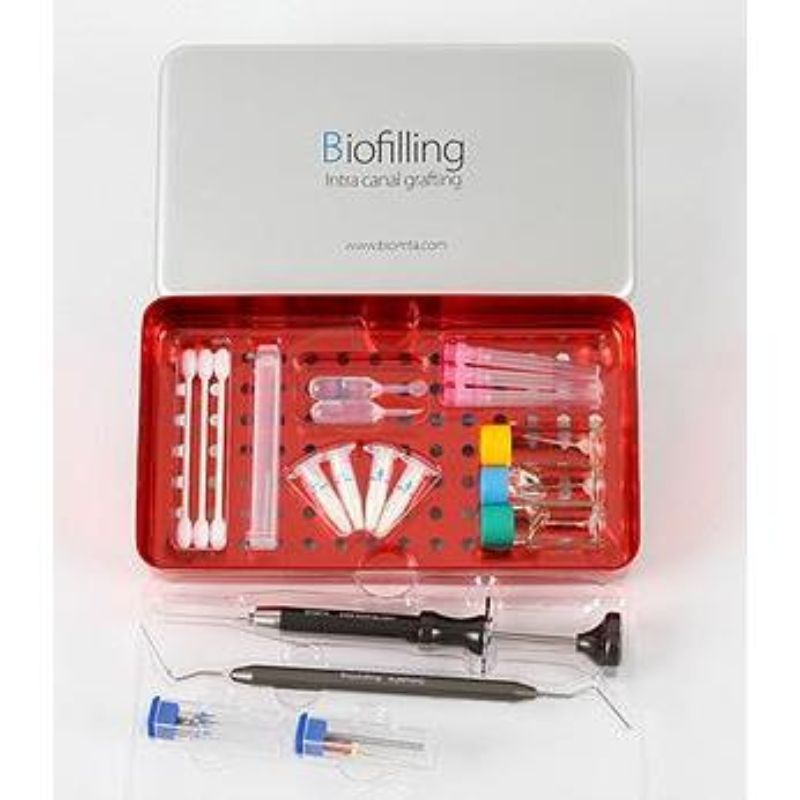
Overview
This device provides unrestricted access to the canal orifice, enabling accurate orthograde grafting with MTA while avoiding graft material dispersion in the oral cavity.
The use of MTA powder in orthograde grafting was introduced by Dr Yoo (2009). BioMTA later developed dedicated materials to improve orthograde root canal grafting outcomes.
The orthograde grafting technique using OrthoMTA has significantly improved grafting quality and overall treatment success rates.
Clinical Focus
The apical 5 mm preparation is critical to ensure effective irrigation, stable apical plug formation, and reduced risk of micro-leakage.
Clinical Considerations
Apical irrigation
Effective cleaning at critical depth
Apical plug formation
Supports consistent obturation quality
Leak prevention
Minimizes risk of micro-leakage
The success of orthograde root canal grafting depends greatly on obturation quality. OrthoMTA provides superior sealing properties compared with conventional materials.
Material Characteristics
~2 micron particles
Ultra-fine size for deeper adaptation
Dentinal tubule penetration
Bonds to the canal surface
HAp interfacial layer
Forms hydroxyapatite at interface
Micro-leakage resistance
Excellent long-term seal
Bioactive response
Supports apical tissue regeneration
OrthoMTA releases calcium ions through the apical foramen, helping neutralize the apical root region and stimulate regeneration of the apical periodontium.
Items Included in the Starter Kit
OrthoMTA Carrier
Plugger OMP-03
Bender
K-File
Plunger (18g and 16g)
Needle Tip (18g and 16g)
Benefits of the OrthoMTA Grafting System
Reduced manual work
Minimal material waste
Excellent sealing / no micro-leakage
Improved clinical prognosis
The Biofilling Procedure
- Preparation: The root canal is prepared, thoroughly cleaned, and irrigated, with a focus on a cylindrical shape in the apical 5 mm.
- Drying: The canal is dried with paper points, leaving minimal moisture for the hydraulic setting process.
- Application: The pre-mixed OrthoMTA paste is introduced into the canal system using the OrthoMTA Carrier.
- Compaction: Use a Compacter to feed paste into the canal and adapt against canal walls for a tight seal.
- Finalizing: The coronal portion is filled, and post-preparation can be performed immediately.
Advantages
Bioactivity
Forms an interfacial hydroxyapatite (HAp) layer between the material and root canal wall.
No micro-leakage
Slight expansion (0.08% for RetroMTA) helps create a tight seal.
No discoloration
Designed to avoid tooth discoloration associated with traditional MTA.
Regeneration support
Calcium ion release stimulates regeneration of the apical periodontium.
Clinical Use Cases
This technique is commonly used for apical plug formation, apexification, and complete obturation of the root canal system.